
Support with Cardiff Council Planning Applications

A strong planning application starts with understanding what Cardiff Council will assess. The Council processes planning applications and appeals in the borough, and applications in Wales are normally decided in accordance with the development plan. If you have received pre-application advice, you must declare it on your application form.
It is understandable to want clarity before committing time to drawings and paperwork. Planning application help in Cardiff can make the process easier to navigate, from preparing your proposal to identifying local requirements that may affect it.
This guide explains how to make an application, what pre-application advice can help establish, and what to expect from Cardiff Council’s process. It also covers how ongoing support and representation can help keep your proposal organised as it moves forward.
Table of Contents
How Do I Make a Cardiff Planning Application?
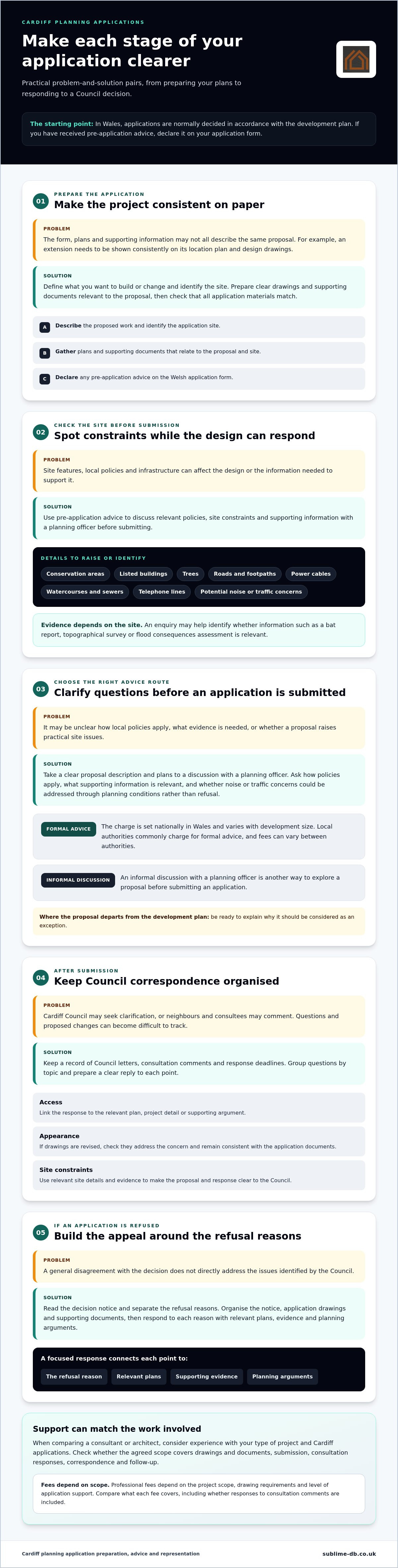
Start by defining the proposed work, then prepare plans and supporting information for Cardiff Council. In Wales, applicants must declare any pre-application advice received on the planning application form.
Application preparation and submission
Describe what you want to build or change, where it will sit, and how the site is arranged. Drawings should show the proposal clearly, and supporting documents should address the specific site and development. Before submitting, check that the form, plans and supporting information all describe the same project. For example, an extension should be shown consistently on its location plan and design drawings.
Describe the proposed work and identify the application site.
Gather plans and supporting documents relevant to the proposal.
Declare any pre-application advice on the Welsh application form.
Planning Aid Wales may assist eligible people with preparing applications. If neighbours or consultees comment, organise your response around the points they raise. Address each concern directly, using revised plans or project details where these clarify the proposal.
Choosing a consultant or architect
Look for experience with your type of project and Cardiff planning applications. Ask how the work will be organised, from preparing drawings and application documents to managing correspondence. A clear scope helps you understand whether support covers submission only or also consultation responses and follow-up.
Typical professional fees depend on the project’s scope, drawing requirements and level of application support, and are given after a quote request. Compare what each fee covers, including whether responses to consultation comments are included. For planning application help in Cardiff, choose an approach that matches the complexity of your proposal and the assistance you need.
Pre-application advice from local planning authorities in Wales
Pre-application advice lets you discuss a proposal before submitting it. Use the discussion to identify relevant policies, site constraints and supporting information.
For sites involving conservation areas, listed buildings or trees in Cardiff, identify their status and features before developing plans. Discuss how these may affect your proposal with a planning officer, then shape the design and supporting evidence accordingly.
Work carried out without required planning permission can lead to an enforcement issue. Establish whether permission was needed and discuss the appropriate next step with Cardiff Council, such as submitting an application or changing the work.
Advice on planning issues
Prepare a clear description of the proposal and take plans to your discussion with the planning officer. Ask how local policies apply and whether the scheme appears to have a reasonable chance of permission. If it departs from the development plan, be ready to explain why it should be considered as an exception.
Use the meeting to raise practical site matters. Roads, footpaths, power cables, watercourses, sewers and telephone lines can affect the design or supporting evidence. You can also discuss whether potential noise or traffic concerns could be addressed through planning conditions rather than refusal.
Planning permission guidance
In Wales, the charge for formal pre-application advice is set nationally and varies with development size. Local authorities commonly charge for this advice, and fees can vary between authorities. An informal discussion with a planning officer is another way to explore a proposal before submitting an application.
For complex schemes, an enquiry can clarify relevant local policies and the planner’s view, without prejudice. It may also identify supporting information, such as a bat report, topographical survey or flood consequences assessment. Ask what evidence is relevant to your site, then use the response to organise the application and its planning arguments.
If you want coordinated support from proposal preparation through submission, planning application management can help organise the process.
Ongoing support and representation
Planning matters can continue after submission, particularly if Cardiff Council seeks clarification or comments arrive. Ongoing support helps keep correspondence, evidence and proposed changes organised.
Ongoing planning support
Keep a record of each Council letter, consultation comment and response deadline. Group questions by topic, such as access, appearance or site constraints, and prepare a clear reply to each. If revised drawings are needed, check that they address the specific concern and remain consistent with the application documents.
Planning Aid Wales may carry out site visits as appropriate when providing support. A visit can help relate a proposal to its surroundings and identify details that plans alone may not make clear. For example, site access and nearby features can be considered alongside the submitted drawings.
Representation also means presenting the proposal clearly in written correspondence. A focused response links each point to the relevant plan, project detail or supporting argument, helping Cardiff Council understand the applicant’s position.
Representation for refused applications
If Cardiff Council refuses an application, read the decision notice and separate the refusal reasons. An appeal should explain why the decision should be reconsidered, responding directly to each reason with relevant plans, evidence and planning arguments. Avoid relying on general disagreement; connect each response to the proposal and the issue identified by the Council.
Cardiff Council processes applications and appeals in the borough. Before preparing an appeal, organise the refusal notice, application drawings and supporting documents so your case addresses the decision. Planning Aid Wales may assist eligible people with preparing applications, while professional representation can help structure appeal arguments and supporting material.
For a clear appeal case, present the refusal reasons in order, then match each with evidence or a proposed design response. This makes the case easier to follow and keeps the focus on the planning issues raised.
Cardiff Council planning applications
Cardiff Council processes planning applications and appeals in the borough. Decision times depend on the application’s progress, including whether information is complete and consultation issues need consideration.
Council decision times
There is no single decision period to assume for every Cardiff application. The proposal’s details, supporting documents and consultation responses can affect how the process moves. Follow Council correspondence, provide requested information promptly and keep copies of every response. This helps you see what remains outstanding instead of relying on a broad estimate.
In Wales, applications are normally decided in accordance with the development plan. The proposal’s fit with relevant planning policies therefore matters when Cardiff Council assesses it. A clear explanation of the design and its relationship to the site helps the Council consider the application on its merits.
Planning application fees
Cardiff planning application fees depend on the type and scale of the proposal. Identify the application category and describe the development accurately before calculating the fee, as a householder proposal and a larger development may use different fee calculations. The fee is separate from professional support or drawing costs.
For a reliable budget, distinguish the Council’s application fee from other project expenses. Keep the application description consistent with the plans, because the proposed work determines the relevant fee category. Cardiff Council processes the application, and the fee is assessed under the applicable planning fee schedule.
Checking applications and constraints
Use Cardiff Council’s planning application records to review proposals in your area. Search by address or location, then read the application documents, decision and consultation comments. Nearby applications can show how particular site features have been presented, but each proposal is assessed on its own planning merits.
Before finalising drawings for your own site, note its surroundings and constraints. Map access points, nearby roads, footpaths, watercourses, sewers and power cables, then consider how they could affect the design. Compare your proposal with the development plan’s policies and organise supporting information around the issues that apply.
For practical support organising your application documents and submission, get help with your planning application.
Sublime Design & Build: Planning Application Management
Sublime Design & Build provides Planning Application Management for homeowners planning a residential project. It can help coordinate the application with plans for a new build or a single- or double-storey extension.
Keeping planning and project decisions aligned helps move the proposal from early design towards the next stage. Building Regulations Compliance can also form part of the wider project, addressing a separate stage from planning permission. The right support depends on the work you are proposing and the level of management you need.
If you’re planning a home project in Cardiff, you’re invited to contact Sublime Design & Build to discuss planning application management.
Shape your next steps with a clear project brief
Before moving ahead, define what you want your home project to achieve and which decisions remain unresolved. Note the intended changes, how the space should work and your household’s priorities. This gives design discussions a practical direction and keeps the desired outcome in view. If you need planning application help in Cardiff, consider how the application fits into the wider project, rather than treating submission as an isolated task.
Sublime Design & Build Ltd offers Planning Application Management, Building Regulations Compliance and New Builds. Considering these parts of a residential project together helps show how planning decisions connect with later design and construction stages. To discuss your project, outline its scope and the support you need, then request a free estimate.
Contact Sublime Design & Build Ltd to discuss your plans and take the next step towards a well-considered home project.
Frequently Asked Questions
What planning permission is needed for common home improvements in Cardiff?
The permission route depends on the work and property: some changes may fall within permitted development, while others need a planning application. For an extension, describe its position, scale and external appearance. For a loft conversion, note roof alterations and visible changes. Site constraints, including conservation-area status or listed-building considerations, can affect which approvals need attention.
How do I apply for planning permission through Cardiff Council?
Submit the relevant application to Cardiff Council with a completed form, accurate plans and supporting documents. First define the work and property boundary, then ensure the drawings match the application description. Declare any pre-application advice received on the form. Keep copies of the submitted documents and application reference so you can track Council correspondence and respond consistently if clarification is requested.
What documents and plans are required for a Cardiff planning application?
Prepare a location plan, drawings of the existing property and drawings showing the proposed changes. For an extension, a site layout can show its position beside the house, while elevations communicate its external appearance. For a roof alteration, compare the existing and proposed roof forms. Add reports or statements relevant to the site, and keep the project description consistent across all documents.
How do I get pre-application planning advice from Cardiff Council, and what does it cost?
Approach Cardiff Council with a concise description of the proposal and plans showing the site and intended changes. Ask which local policies apply and what supporting evidence is needed. In Wales, the charge for formal pre-application advice is set nationally and varies with development size. Local authorities commonly charge for advice, and fees vary between authorities, so the proposal’s scale affects the applicable charge.
What are Cardiff’s rules for conservation areas, listed buildings, and trees?
Identify the site’s status and features before developing plans, then discuss with a planning officer how they may affect the proposal. Shape the design and supporting evidence around those considerations.


Comments